Woods Sharpening: How To Sharpen Steel

"An edge is formed where two plains meet"
No matter how much you spent on your knife; it's not going to be worth anything after three days of use in the trees.
If you find yourself pushing the edge of a blade into an object or otherwise not slicing, stop, sharpen, or figure out how to reach a material that can be sliced. If it won't cut, stop. A ready edge does not need a sawing motion.
Take care of the leading edge. Don't pit it or ding it.
You can grind off the bevel with concrete or good sandstone. Diamond files are great too.
Grinding bevel is the first major component to bush sharpening. Dont get discouraged if the edge is not biting at this point. Wipe the rock surface and hold an angle.
For sharpening, any smoothish rock is the natural prescription, but sandier stones are usualy better. Granite, which is most rock, is dense and harder to grind steel but fine for getting the razor back.
Sharpening a knife is done by feel. The initial, crucial step is to ALWAYS begin by grinding the bevel, accomplishing two things—reducing the bevel and feeling the bevel grind, knowing this feeling. As said above, grinding bevel is usually a smoothish feel. Keep going though as you need to remove this steel. If the feeling is too smooth, its because the stone is loaded and needs to be wiped.
Typically, you rake the smooth bevel on a rock UNTIL THE FEELING CHANGES and you just see rock dust fly. Hold a desired angle until the edge is formed. When in doubt just hold out a little longer. Once the feeling changes, the angle is edge ready and the knife is sharp.
To reach the leading edge sooner, while rubbing and grinding. Slowly. Riding the bevel on a smoothish feel until the feeling just changes to a gritty one as the edge reaches the surface. Back off, grind, and then again check for the true edge. USE THE BEVEL TO MAKE THE LEADING EDGE JUST BRIEFLY TOUCH. Lighten up if you must to feel; touch up to the true cutting edge. Complete the whole edge. Use a constant rub for continuous feedback for the right grind.
After a while of practice you will get a good grasp of the feeling. Resist the urge to put a slow, heavy grind right into the steel. You will get an edge quickly, but miss the opportunity to grind bevel if you go right to the leading edge. Use a continuous motion.
You have to FEEL and sense a sharpening process; otherwise, you'll be reducing steel where it need not be reduced. This feel will take time to hone, and focus may be lost at times, along with hope, but stick to it as with everything.
Keep in mind a leading edge is microns-thick steel, so you don't need to apply too much pressure to a leading edge.
If you don't have a perfectly smooth surface, remember the most important key—feel the smooth, obvious bevel on a grind, then transition to FEEL THE SUBTLE shift in bite, keep it brief, grind, and then move on.
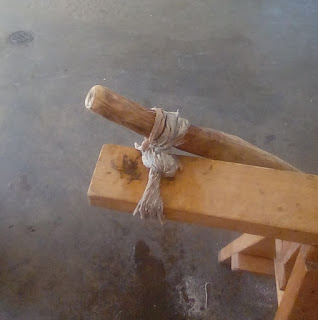
The edge should be utterly terrifying (especially if your granite is smooth), but it's time to turn it into a LONG LASTING glass-sharp edge—the final step is stropping. You can use a piece of cardboard, but what works far better is a thick strip or thong of bucked, smoked moose hide; a thick suede thong or a thick flesh-side commercial hide will do too. A thick, long thong of buckskin soft moosehide is far more mobile than a strip glued to a wood board. Tie as shown to a branch or other stationary pole, pull and hold taut, run the blade, spine leading, side flush angle with the leather, back and forth. You will quickly feel the leather cleaning and polishing the rough-honed edge of your tool. No compound required.
Stropping is not necessary, but it will make the seemingly sharp edge last much longer by pulling off the burrs that will soon fold over and make your edge seem and act dull. Take the time after each stoning to find a leather strip or some other material to remove the burrs. This is one of those time spends that pays off as less time spent in the sum of the long term.
The best leather I have used is heavy moose thong from the periodically stiff borders of a moose-bucked hide; this type of leather will last a long time and stand the strain of tearing off tough burrs formed from your apexed tools and putting that terrifying glass edge on.
The hide can be gnarled and tough in sections and uneven; just make sure your knife face is initally flush with the strap. One strip required.
If you are using good steel, you like your knife, or you need to extend the life of the steel, test the strop often over the stone.
If you are wearing buckskins, a sleeve or pant leg will do.
A flat of cardboard also works great.
Both can be used with a feel. Rub the smooth bevel; feel for the difference as you change the angle. Lighten back for a glass edge. You'll know it's sharp when you nick yourself shaving and not notice.
When butchering, however, it's more practical to quickly rip the edge over a strip.

You can follow an angle with your thumb, use careful strokes, use all sorts of expensive stones, lye water to keep the surface clean, have a sitting posture, &c. &c., and it will work; but by feeling the touch grind, it becomes the practical, need to know, old as time, in the field, touch and go, with any rock way.
Use the same technique on axes or scissors.
Materials have their characteristics. Commercial sharpening stones are designed for the task of removing metal, though i dont find annadvantage to using them with my techniqu. Granite and other natural materials work well for removing iron, especially if you think about what you are doing and have good skill.
Obviously, you want to use more abrasive stones for reducing bevels. Choose the angle you need and work the steel on a abasive surface until the bite changes. Hone on a smoother rock.
You can extend a flat surface by rubbing a rock against another.
People get tired of knives because, for whatever reason, they neglect to keep the pace of grinding the bevel with the sharpening of the secondary bevels and leading edge. Grind down the steel, and find useful life again in any chunk of metal.
PLEASE - Don't stand there massaging a hone or $200 rock. Guys make a expensive science out of it...

Key: use your senses.