How to recover from a major injury or surgery without oral antibiotics.
To start off, the choice to not follow the instructions of someone who is old and would thus have many years of experience both treating and also covering his or her ass from lawsuits by suggesting routes that deviate from strict guidelines set by insurance companies that would immunize him or her from financial loss is a heavy one. The risk associated with an infection from a deep laceration or dirty puncture is immense and may result in the loss of a limb should you get infected and it become severe enough. The infection, along with swelling and accidental tension, may undo internal sutures needed for optimal recovery. So say you do get the wound stitched; a small infection will also hinder or affect optimal recovery.
All things to consider.
The trick in life is to do everything you can to avoid ligament joint or tendon laceration, brain trauma, &c. Any injury, in fact, as your body will never be as good as before. Easier said than done.
If you think real-life recovery emulates anything resembling something you see in an American Hollywood film, you are in for a painful reality check.
Rather than looking at this as instructions to not take antibiotics or how to not take antibiotics, because the reality is, when you get to any given age, God wants your soul, and He'll do anything to get it, look at this more like a good guide to support any additional treatment you may choose.
My health has been a lifelong occupation.
- There are huge deviations in healing prognosis from one laceration to the other—in the same person. Barring generally good nutrition, if you make a deep cut in your flesh with a dirty ulu and it's open for four or five days before a surgeon closes it, the infection may be immense. If you have to go in and have the laceration done on you, in a sterile environment with clean tools and hands, in and out, without antibiotics, you MAY not even have any swelling. When the laceration occurs, it must be attended to immediately, fast, and kept clean and sterile. If you can, get the wound washed and use a sterilizer like iodine water, antibacterial soap, vinegar, or saline water, but the former is best imo. It is imperative that the wound be closed ASAP.
- If the suturing or closing of the wound is done by you, with or without inner sutures, you MUST clean the wound with an antiseptic before closing. Vinegar, iodine flush, and saline solution are last choices in my opinion, but I think it's ok if it's all that you have or can make.
- Get PLENTY of well-timed sleep. This helps the immune system fight infection and speed recovery.
- REST, REST, REST. I know you want to be a hero or think you are, but you must be real. Give your laceration, the ligament, or the tendon time to heal, and if this is the latter two, with surgery, we are definitely talking at least six weeks without use at all.
- Ease into movement. Trust time and your OT if you have one second. Wear your splints. Follow dillagence. I have been there, and it's better to give it the right recovery than live a life of regret. In that same vein, you must gently stretch the recovering tissue so you reach optimal post-operation mobility. Focus while doing the exercises on the feeling of feedback from the tissue. Stretch but stop if you feel any pain and let it rest. Scar tissue forms 24 hours after injury, but the tissue does not know how to grow properly on its own, so it must be guided by expectations of proper movement, or you will end up with long-term stiffness. Joint laserations benifit from movement and gentle stretching early on, and this coaching is where a competent, experienced occupational therapist with a surprising arsenal of acute tricks is very helpful. However, if your gut says rest it, do so. It is better to rest it than worry your scar tissue will immobilize the area permanently. This is a comex subject with regard to the full recovery of a laseration or injury and beyond the intended scope of this article (which is the avoidance of antibiotics on the road to reconnecting the torn tissue). Do your own research on scar tissue recovery.
- Don't eat junk, nutrient-free, calorie-dense, random-ingredient-laden food.
- Eat clean, fresh food. If your body is fighting an infection and bad food, it's not going to be a mortal's mission.
- Exercise and work are good and fun. Having goals and physical stress doesn't seem to hamper recovery as long as your stitches or wounds are not affected or stressed in the activity.
- Eat plenty of fresh fruits and herbs with a lot of antioxidants and vitamin C: cinnamon, horse radish, inner spruce bark, spruce tips, rose, Solidago canadensis, and peones pettals. I ate at least two lemons every day while recovering. Cheating, yes. Expensive, yes. Do I want to risk failing a surgery for a hand ligament? NOPE. And I live in the land of "free healthcare"...
- Keep the wound clean; cover all affected areas with polysporin or similar antibiotic topical cream.
- Do know that tap water spreads bacteria.
- (big one) Eat plenty of gelatin broths or other collagen-containing soups and ligaments: eat what you want to recover. Make sure that when you get those hoofs, you are saving them for this purpose. The body protein is 35% collagen, and this protein must be cooked to absorb in food.
- Keep the wound clean and dry. Modern plastic casts have very few and small ventilation holes. Make the holes a little bit bigger or add a few more around the area where the wound is located without affecting the structural integrity.
- Bad bacteria want to attack dead flesh and meat. Keep the wound clean. Dress your wound twice or thrice a day.
- At a certain point, any moist topicals become more of a hindrance to recovery than an aid. The wound needs time to heal dry. If it still appears slightly infected, keep changing the gauze dry.
- Here are some good videos: 1 2
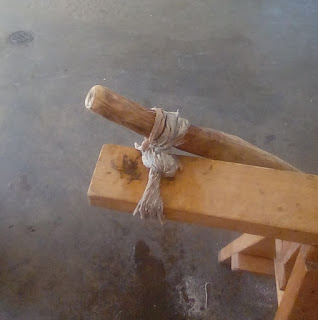
A pincer idea if your hand is out of commission. You may also consider a strap skewer to the wrist like a wood or metal spike for poking meat. For pulling game apart, I use a self made meat hook, strapped to a leather thong and my arm would do the pulling, well away from the injured hand, which, at this point, is well into recovery. The risks, responsibility of any and all of this are still all yours.