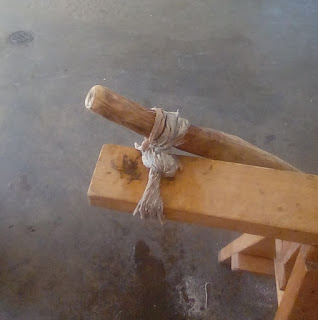
What is “arrow spur”, and how to use it
The spur will accelerate an arrow into a target and extend the distance it will travel—in other words, increase the performance of the bow from that which would be expected where the limbs were acting on the arrow alone. In essence, the spur is an additional skill an archer can learn to increase control over the arrow power and distance; however, if the archer is lacking in skill of using the technique, or when he begins using the spur, he can compromise the accuracy of the shot instead of increasing it.
Doing the spur well can initially be a difficult maneuver to exert on your shaft; however, in time, it can be an ever-shot mechanism. It takes many failed shots to acquire the feel, the perfect balance of forces needed to be applied to your bow hand, to shoot the shaft true, fast, AND to strike your mark.
Once the string leaves your drawing fingers, your bow hand must take full control to keep the shaft true; you won't have this, however, until you practice the feeling to move that arrow to its target, into your being.
Thus, the arrow spur can be best understood if you pick up a slow 30# bow. Release the string with the nocked arrow and feel the weight of the arrow. The goal is to push the arrow into the target without letting the fletchings strike the stave. Release the string and feel the power point as it pushes a shaft. You do not want to preload the bow before it reaches full draw. Then a focused power is exerted on the stave during the shot cycle.
Wait until the arrow is shot before power is applied to rotate the bow forward.
The spur is an adaptive movement and based on the requirement of the shot. Generally, the bow hand movement is a forward push and a rotational "lift up" of the limbs—but the arrow MUST stay true through its flight. Practice by taking long shots and note the flight of your arrow.
You also must remember the slight rotation sideways to the stave to achieve a linear movement for the bracing string; this is a "khatra" rotation, which you should already be comfortable with as an archer who shoots a shelf-less bow.
If the arrow fletching is cutting you, you are doing the spur wrong and must change your hand movement. You aren't "feeling" the arrow. You can use a thumb guard that is thin—a sting will tell you that shot was wrong.
You should get to the point where the spur no longer is something you "do" or achieve but just implement naturally to ensure that a given arrow reaches or gets driven into the target.