Saws, Axes, Hatchets, Big knives or Tomahawks.
Saw: These are great for butchering game—ribs, sternum, pelvis, and other bones. Battoning a knife will work, and axes make a mess of things. You greatly benefit from having these for moose, but butchering trees may be different. The reality is that I haven't used these in the bush for butchering dead standing for a fire, cover, or sleep platforms. My immediate assessment, however, is that they seem like more work than the alternative. The nice thing about saws is that they are extremely light as compared to alternatives and so easy to keep sharp; they may fall apart due to poor construction, but this is true of both axes and knives too. The blade can also snap. Some guys really stand by folding saws, and I can see their use with a robust build.
Felling Axes: heavy. You need a horse or ATV to use these regularly in the bush.
Hatchets: again, heavy to carry on a march. The extra heft may help when butchering bigger trees, and these can also be used for skinning by using the blunt back to tamp the hide off.
The biggest problem with choppers is the noise they produce in camp; this can be a factor of you are hunting.
Big Knives: Something that tries to do everything, does nothing well, but does do everything. The Hudson's Bay Company made a knife for the old trapper boys outdoors, which was demanded and made useful. Great for batoning wood or chopping game. Poor for chopping wood often—but I'm sure you can get used to an efficient approach. Every pound needs to be useful. A large knife can function both as an axe and a butcher tool for game, so it's likely a good choice, though I have never given it a good chance.
What I like about big knives is that on many occasions while butchering you will come to a place where a little heft is useful, and you can move seamlessly through it without grabbing another tool like an axe, saw, or stick to baton through it.
Like with axes, you can baton through a stick to process it. The knife needs to be set at an angle before being driven through. An angle allows the wood fibers to be pushed away as the blade goes through as opposed to pinching the blade when driven directly perpendicular to the growth fibers.
Chops need to be tactful and thought out. If you are using a axe prone to dulling, light or both, I prefer a deep side cut and then another three inches lower at the same angle. Try to twist the axe so the wood pops out and moves. Think about your chops and guide the axe to knock out chunks where chunks are most efficiently removed to make new space where you need it most. When you have made your cut deep enough, which is usually to the center, you can probably crack the log in half; this is for wrist-sized logs. Wider logs are chewed narrowly.
If you really needed a saw, and maybe you want to do it anyway, maybe angle grind one into the spine of your knife. It takes work to be as good as a real saw, but it can throw a good spark from a fire rod and save other functions, like adding traction for a finger.
Let's be real, a knife is not as necessary in the bush today—unless you are constantly cutting meat from hunting, in the bush, or cutting yanki scalps—which is a rare situation.


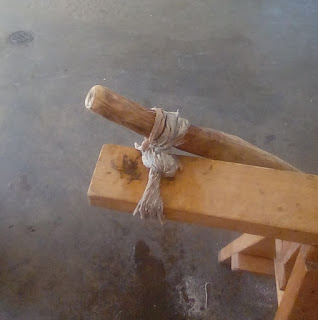
In a long-term, hard-use situation, I would not want a hatchet, axe, saw, or the tomahawk shown above. Saw blades break, and you need a special tool to sharpen them. Axe or hatchet heads can come loose, and you need other tools to service them. The tomahawk shown above needs a drill tool to make holes in a new handle, which may be done by making a project of it.
The tools I would opt for would be a traditional tomahawk (boarding axe) or big full tang knife of a soft 1075 high carbon steel (higher 10s for a durable edge but are harder to sharpen), which is exactly what history also shows was most often demanded.
At the end of the day the reality is - use what you have, its all better than a rock or broken bottle.
Show support - https://buymeacoffee.com/ropesuspenders