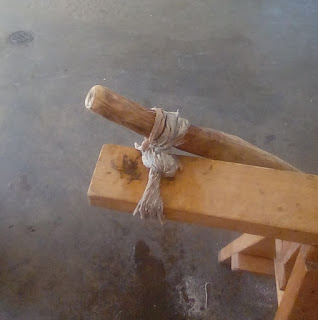
Haft an axe head to a stick.

Rough finish the length and shape for your handle.
Your axe head should be sheet steel, cut to your designe preference.
For my axe, I used an old circular saw blade cut to an appropriate shape; this shape must include, a blade, a bar in the center section that will fit into the wood, and a back end. The steel in these saw disks are not hold an edge blade steels - in fact, the edge will warp with twists if hollow ground - but it works fine - it's cheap, redilly available, thin and light, easy to sharpen, and I don't need a forge of any kind to make an axe that can maul bone (if you can afford to maul bone with a 300$ axe you don't have the time to be mauling bone) or wood. Consider also axes were sharp rocks and they made great service for thousands of years.
The back can be whatever you want or be omitted entirely; for mine I chose an arrow shaped tool.
The bar, must be about the width of the wood handle stick and must include notches cut into the end of each; these noches are what I use to snugly fit and hold the heavy bracing nails, driven perpendicular to the axe head, through the wood.
I cut a separation into my wood handle with a skill saw, through the middle of the dowle, and following the grain of the wood - this is important for maximum strength of the axe.

Next, take your axe head and put the bar section on the outside of the shaft, next to the separation you have cut. Poke a dot into the wood where the bar sections of the heads grooves are, to make sure when you drive your drill through, the brace pieces will be lined and located correctly in the center of the wood dowl.
Drive a drill thought the wood the size of the width brace peices, which should also be the width of the u groove cut into the middle bar of the steel head used. For the first attempt at this, I used thin nails wich did break and fail. For this one and yours, use something with more girth so the impact of axe use has more wood surface working to mitigate and prolong axe life and the steel braces dont wear and break.

Above, top to bottom, the nail stock for this project, a pin brace for this project, the nail stock that failed the first time I used this aproach.

Fit your axe into the dowles separation and push your brace pieces through the dowle.
Grind or cut away any protruding material on the other side of the dowel.
Whet a length of babiche about 2 and a half feet long to a full soak. Using pliers, tightly bind the dowel beneath the heads postition, then transition to above the axe head - here is the key to tight binds with leather - once both are wrapped, you should have about half a foot left; using an awl, weave under the binds made on both the top wrap and bottom, and pull tight; this will twist the loops, which are already tight, making then far tighter.
The wraps will bind the wood and prevent vertical splitting. Binding will also cover the brace peices for the steel axe head, keeping them from sliding or slipping out their wood holes.
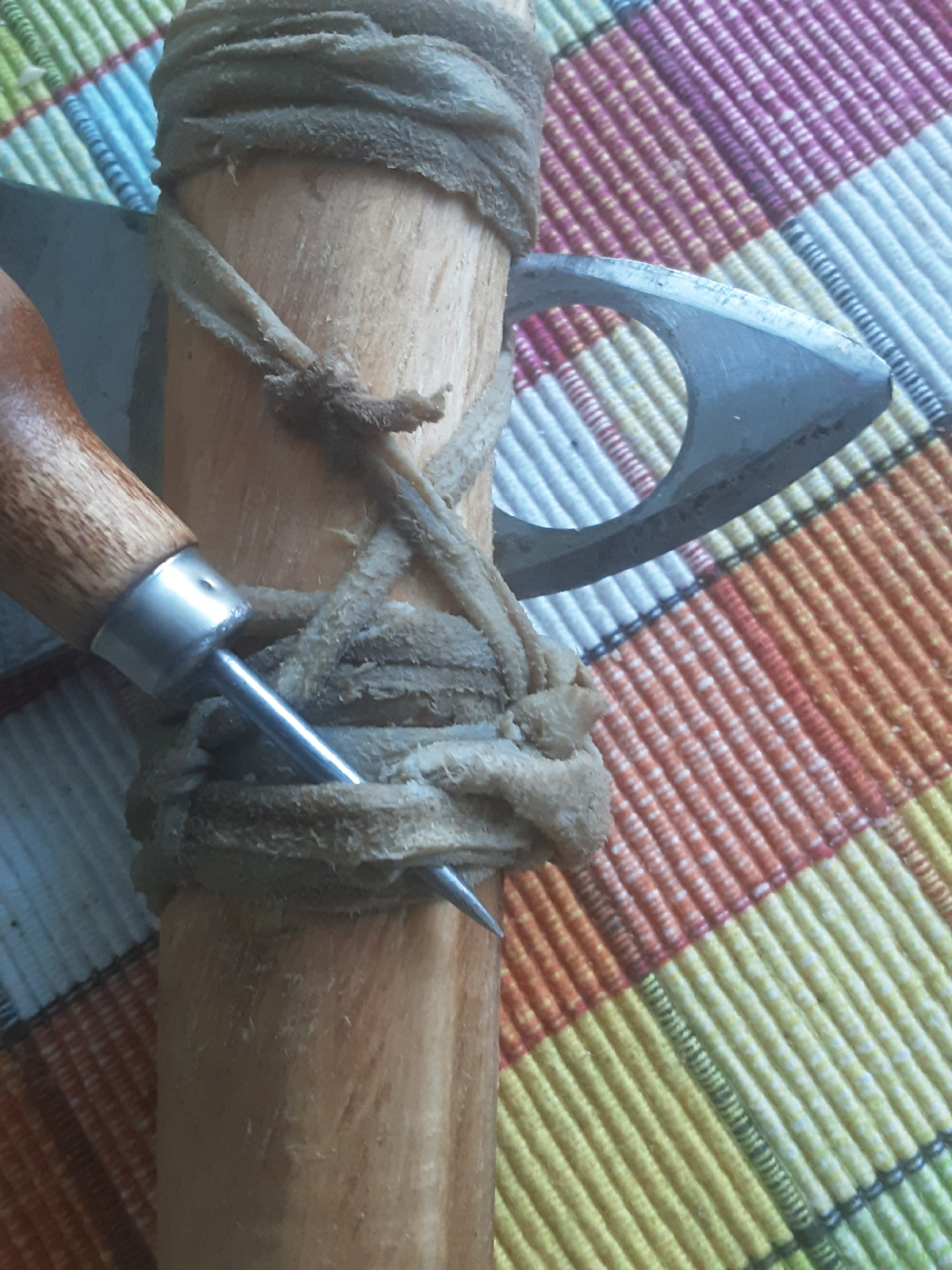
Finish off the babiche, and let it dry.
Add oil to the handle to prevent stains and bring out the wood grain.
An alternative (or in this case an addition) to babiche can be a length of iron cord. Wrap using pliers. Iron has the advantage of resisting abrasion that will come from axe use.
Update: eventually, after much use and strikes, the wood split at the holes for the pins, then the splinter broke loose. The simple solution is to make the next handle with a more robust amount of wood for the head mount portion and matching same stock pins. A fine handle she was.