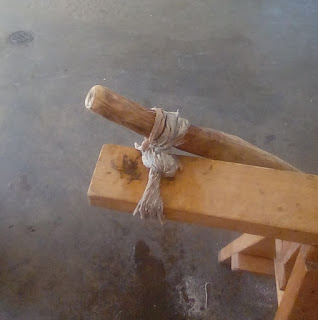
Initially I thought to scrape the hair off the hock section. Which I did. The lower leg sections were stretched on a wood plank and dried. The hair was shaven, as I didn't think the insulation would be helpful in a summer mock. Later a suggestion was made to use the hair side as the bottom of the mock, which made sense as the hair would need to be worn through before reaching the leather.
I roughly scored a trace of my foot on the hide and cut through with a knife and tamped along the trace.
I found some cull buckskin for the top and stitched a top. It would probably be best to use the strongest hide you can afford.
The purpose of this mock is to save finished buckskin for less laborious leathers in use at high traffic points. The lower leg rarely has a constructive use for me.
Time in the green will form these right up to your foot.
Update: A win thus far. The hair has yet to wear through. The whole moc will form right up to your feet in the damp and stay after. A mistake one can make is getting cheap on the upper part of your mock. I have always found that a high top is preferred for the feeling of a secure shoe and protection from bugs and bramble cuts to the lower leg. Additionally, I AWAYS make the shoe cut to shape and for the sole this is AWAYS a mistake. The sole always wants to shrink up, shortly after initial use, at the heel. Always oversize your sole. In a raw hide sole moc, the next sole will have an over extended heel, almost designed to reach behind the foot at initial try-on, to protect eventual shrinkage and thus wear to the stitch where the heel sole meets the moc support.
Additionally, you must make time to heavily smoke the rawhide material for the sole. Stretch dry, then smoke the hide; this will prevent smells of rot, inhibit hair slippage, and maintain the set shape after repeat soaking.