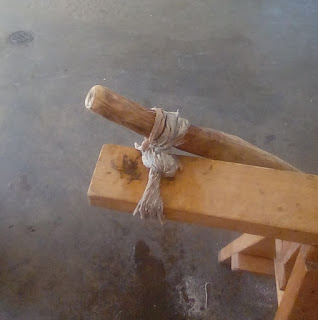
A Suggestion for Reducing Wood And Truing Stave Limbs.
 |
| Make sure that either the wood or file/rasp are viced or clamped down. Many vice down the wood. It feels natural to work wood on viced rasp. This feeling may be rooted in having worked wood on a large stationary rock. Limited experience however has taught me that rock tends to gum-up rapidly or lose its "edge" when abrading wood. |
I have made many shafts from cut lumber, but not many bows. For shaft, I reduce a hevy amount of wood by just carving it off with a sharp thin knife (like a safety razor) and then taking it to a rasp, file or blade perpendicular to the wood. Your hand will get faster and more accurate at whittling down a shaft to make it ready for the rasp and file. The wonderful advantage of making your own shaft is realizing all the knock and shaft combinations and possibilities and how they behave in practice. With a store or pre cut shaft you are limited to the linear rod.
To true a limb, I dry heat the limb through to toast. My bow limbs are usually toasted to improve performance; this is done prior to the final tiller. Once the full limb is toasted, I maintain the heat and then take the limb to a stationery. Vice handle section in with a cloth to prevent digging. Wrap a strong, long folded cord around the limb so the centre is the end. Place a long post in the U end and twist, keeping the cord tight until your limb reaches true; go a little further and hold until the wood is cold. Repeat the dry heat and twist process until the limb is true. If you use wet heat, it will take much longer but you are less likely to damage the stave. You may need to repeat the whole process during the final tiller.