Gold at the Bottom Of A Smoking Tar Pit - Stoping bug bites naturally, day and night
Day and night (unless you use a modern polyester tent), biting bugs are the worst enemy of your enjoyment in the summer months outdoors. Here are my best (less well-known) solutions to deal with them.
Initially, generally, mountanous areas have fewer mosquitoes. Flat areas with stagnant water will harbor mosquitoes. The afternoons will be worse. The sun generally makes the mosquitoes hide, but even on a clear,, hot day, if walking in the shade of a water-stagnant-rich area, the swarm will find you. The mosquito is more tenacious and will require a thick layer, but no-see-ums and other small biting bugs can be stopped with grease on your skin—any natural grease or oil you are fine with absorbing through your skin.
In the sun, the bugs typically won't bother you, but in the shade of wood and or tall grass or later in the day, smoked hide for the legs and torso and a heavy grease on your face and hands will help you reopen the outdoors without the need for harmful bug sprays.
If you don't have grease, do as the Arab women do and cover your face and forehead with a rag or shemagh scarf that is loose. Fold corner to corner so the scarf becomes atriangle, andd fold over the long upper part (of the upsid-down triangle)) again to achieve close to four layers of cloth, necessary for the forehead. Put the left side on your forehead and wrap the remaining 2/3rds around the back of your head and over your mouth. Tie the ends together and adjust to cover your mouth and as much of the forehead and corners of the eyes as possible. It's difficultt to cover your head using said tie, so you'll likely use this tie with a hoodie or second scarf. All merciless in the scorch.
The most challenging time to endure bugs is while asleep.
To keep bugs off your face during the night, you may try to use the same shemagh scarf and two of the same side corners together to make a small cape. Additional covering for your headcap and forehead and will also need to have an elevated head while you sleep. Drape the shemag cape material over your face and chest. The shemagh is typically made of a light, delicate material and will easily tear if branch gets caught in it.
If you havea mosquitoe net, you can use a three stick bivvy. Find three fresh meter long sticks. Plant two in the groud, x fashon to each other, in a curve, to plant the other ends of each. Plant the third above and lead the end under the bent sticks. The final product will be a dome for your head and maybe shoulders, to drape a skeeter net over. I have tried a bead spread, but the material is not breathable enough.

Any opening will be exploited and any fabric touching skin however. So this is actually a non option.
Idealy, what you need is an item with rigidity that can make a near airtight seal around the head, over the eyes, and up to just beyond the nose. The rest must be breathable, like a fine mesh cloth, like a shemagh, something that will not inhibit airflow for breathing into the chest. A leather hood to cover the nose, as stated, should be ideal.
Further experimentation is required for a confident confirmation.
Usualy, mosquios calm down at night fall but dont count on it.
A game changer option I found during the day, for the forehead is to use the hair over to the side and across the forehead if you have the length for it (or just long bangs like the natives shown in some George Catlin photos). You won't over heat like other options. Its not a perfect solution to bugs, but it slowes them down, you wont be looking down all the time or swatting your brow to keep the bugs off your face, and so you can focus more on whats ahead.
An idea I had is to also drape strips of lether from the brow of your buckskin hood. I have yet to try this however.

Though not technically a native cultural feature, it would not be difficult or impossible to fashion some loose buckskin gauntlet mitts or gloves; this would halt all bug bites to the hands.
For the fee—moccasins. I am strongly inclined to believe that the moccasin was not worn at every momoment butore like slippers during sleep and walking where and when fofootwearould be logically necessary.
Yet another approach, though typically immobile, is a small smoldering smudge of smoke. The smudge can be any material that creates smoke—even dry wood on a hot bed of coals.
If you have made an evening fire, simply throw some thick stick chunks, leaf lilitter, or any thing on the coals to let it just sit there and smoke as long as you need.
Your smudge can become mobile with a pot, can or other container holding the leaf litter or other smolder material. Maybe this is why Ozii had a mushroom necklace. Some shelf mushrooms will hold a smolder and these beads may have been lit to smolder and distract assaults from bugs.
The smoulder wont distract all mosquitoes, but it will, soon after lit, about 90% of them.
 |
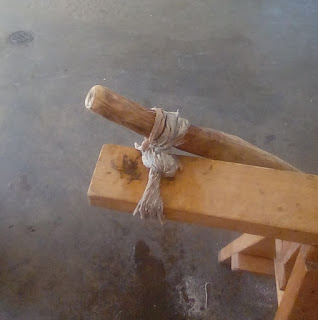
| A somewhat "self feeder" smoker. I suspect that said approach is the origin of the "smudge" for spiritual cleansing practices where dried herbs such as sage are smoldered and wafted. Perhaps it was common to use where a fire was not present to "clear the air" of bugs and bad spirits in a small tent structure, for example. Sweetgrass has been found to deter mosquitoes as well as DEET. Use respect when harvesting these herbs. I have spread wood ash in the harvest areas in the past to help the plant regenerate. An idea to try may be a necklace that holds braided smoking material; I saw that in a movie based on true events once. Mud does prevent mosquitoes from biting, but there are other biting bugs, which are likely in the same location, that not deterred by the wet mud. Mud can also dry quickly, and when dried, will rub off. So you must be aware of which mud you choose. I have used black mud, which will easily rub away when dry, and a fine grey clay I found to cling better but more experimentationtion is required. |
I feel grease and good clothing has most often, traditionally, been the go too approach.
Show support - https://buymeacoffee.com/ropesuspenders